Showing posts with label druid. Show all posts

Tuesday, 1 September 2026

Diablo 4’s Nafain’s Bestiary Set May Not Give All Companion Upgrades

Diablo IV's Druid has spent a good portion of 2026 learning that having more animals does not necessarily make life simpler. A fresh bug report is now questioning one of the class's most interesting Talisman sets, Nafain's Bestiary, because its five-Charm bonus appears to promise more Companion upgrades than the game actually provides.

The current tooltip says the completed set lets the Druid gain an additional Bear and all other Companions of each type while also granting “all Companion Upgrades for free.” According to a report posted on August 30, however, the final upgrades at the end of the Companion skill branches are not being granted automatically. That leaves two possibilities: Nafain's Bestiary is not functioning as described, or the wording is broader than Blizzard actually intends.

There is an important wrinkle. This is not the first time players have investigated the set. A separate discussion from May suggests the intermediate Companion upgrades do work even though the skill tree does not visually show them as allocated. The final modifying upgrades, however, still require the player to spend skill points. So Nafain's Bestiary may not be completely broken. The real problem may be that “all Companion Upgrades” does not mean what most players would reasonably expect it to mean.

Nafain’s Bestiary Says You Get All Companion Upgrades for Free

The current five-Charm description is difficult to read any other way. Complete Nafain's Bestiary and the set grants additional Companions while telling the player that all Companion Upgrades are free. For a Druid building around Wolves, Ravens, Poison Creeper and the wider Companion package, that sounds enormously valuable because skill points normally spent completing those branches could theoretically be redirected elsewhere.

The new bug report specifically calls out the fact that the final upgrades are not provided. The player therefore asks whether the set is broken or simply phrased incorrectly, which is probably the most useful way to frame the issue until Blizzard clarifies the design.

If Blizzard intended every upgrade node attached to a Companion skill to become active, then part of the five-Charm bonus is missing. If Blizzard only intended the secondary or “side” upgrades to be granted, the current tooltip needs to say exactly that.

Those are very different bugs, but they create the same problem for somebody trying to build around the set: the item tells you one thing while the skill tree behaves as though the promise came with invisible fine print.

Players Already Tested This Earlier in the Year

A May discussion provides useful context because several Druid players initially believed the entire upgrade portion of Nafain's Bestiary was failing. They equipped the completed set, opened the skill tree and saw no indication that the Companion upgrade nodes had been activated. The nodes still appeared to cost skill points.

One player eventually tested the actual effects rather than relying on the interface. Their conclusion was more complicated: the side upgrades appeared to function despite not being visibly highlighted in the skill tree. They tested Poison Creeper and Ravens and found effects consistent with those secondary upgrades remaining active.

The final upgrade nodes were different.

Those apparently remained unavailable unless the player manually invested the required skill point. Another participant reached the same conclusion, explaining that Nafain's Bestiary provides the side upgrades but not the major final modifier at the end of each Companion branch.

That makes the August report particularly interesting. We are not looking at one player suddenly discovering that nothing works. Players have apparently understood for months that part of the set works invisibly while another part that appears covered by the wording does not activate at all.

The Tooltip Is the Real Problem Even If the Set Is Working as Intended

Diablo IV has a vocabulary problem here. If a tooltip says “all Companion Upgrades,” most players are going to interpret “all” as a fairly ambitious quantity.

Usually somewhere around all of them.

Blizzard may internally distinguish between normal Companion upgrades and the final skill variants, but that distinction is not obvious from the set description itself. A player should not need to visit a forum, read a three-month-old testing thread and manually verify Raven behaviour before understanding which part of their five-piece set bonus exists.

A clearer version could say something like “gain all secondary Companion upgrades for free” or explicitly state that final Companion variants are excluded. That would immediately tell players how many skill points Nafain's Bestiary actually saves and prevent them from planning a build around bonuses they were never supposed to receive.

If the final nodes are supposed to be included, of course, then the wording is fine and the implementation needs fixing.

The Skill Tree Not Showing the Free Upgrades Makes Everything Worse

The confusing tooltip would be easier to live with if Diablo IV clearly displayed which free upgrades were active. According to the earlier player testing, it does not. The side upgrades can function without being visibly allocated in the skill tree, leaving the player to determine their status through gameplay testing.

That is particularly awkward for a build-defining Talisman set. The entire point of these sets is to change how characters are assembled. If the set grants several skill effects without spending points, those effects should ideally be reflected somewhere in the interface so the player can see exactly what has changed.

Otherwise, every questionable interaction becomes a miniature laboratory experiment.

Does the upgrade work?

Equip the set. Find the correct enemy. Trigger the Companion. Watch the buff bar. Count the effect. Remove the set. Repeat.

That is useful work for theorycrafters. It probably should not be the normal onboarding process for an item tooltip.

Season 15 Is About to Make Nafain’s Bestiary Much Stronger

The timing matters because Blizzard is already buffing Nafain's Bestiary for Season 15. The official 3.2.0 PTR notes reduce the two-piece Battle Roar cooldown to five seconds, while the five-piece bonus is being expanded to provide an additional 250% multiplicative Companion damage. Blizzard is even making the Companions grow slightly in size.

In other words, this is not some forgotten leveling set Blizzard is preparing to abandon. Nafain's Bestiary is receiving direct attention in the next major balance pass.

That makes the upgrade wording worth fixing before the stronger version reaches live servers. If Season 15 pushes more Druids toward a Companion setup, substantially more players are going to complete the set and discover that “all Companion Upgrades” apparently excludes part of the Companion upgrade tree.

Blizzard is increasing the damage.

It would be a convenient time to increase the clarity as well.

This Is Another Talisman Problem Where the UI Cannot Quite Be Trusted

Nafain's Bestiary is unfortunately arriving in a system that has already given players several reasons to double-check what the interface tells them. We recently covered reports of Talisman set bonuses stopping during combat, while other players have encountered Seals that refuse to accept Charms or leave completed set bonuses greyed out.

A separate live bug thread has players reporting that some higher-quality Seals simply refuse to accept particular Set Charms at all. Others describe moving a completed five-Charm setup onto another Seal only to have its two-, three- and five-piece bonuses become inactive despite the Charms still visibly occupying the slots.

That issue is technically separate from Nafain's Bestiary, but the player experience is similar. The Talisman interface can show one configuration while the underlying bonus behaves differently.

We also recently looked at how generic Set Charms may effectively disappear from the expected loot pool once players move into Torment. Talisman power itself is interesting; understanding exactly what the system is doing has been the harder part.

The Druid Does Not Need More Invisible Build Math

Companion Druid is already full of interactions involving active and passive Companion effects, skill ranks, individual upgrade branches, multiplicative bonuses and equipment that changes how those Companions behave. Nafain's Bestiary is meant to consolidate some of that complexity by saying, in effect: complete the set and we will give you the Companion package.

Instead, players need to know that there may be three different categories hiding behind one sentence:

  • Additional Companions, which appear to work.
  • Intermediate Companion upgrades, which reportedly work but are not visually marked in the skill tree.
  • Final Companion upgrades, which reportedly are not granted and still require skill points.

That is a lot of interpretation for six words.

It becomes more important when players are optimizing skill points. If a Druid believes Nafain's Bestiary covers an entire Companion branch, they may spend those points elsewhere and unknowingly miss a final modifier that their build guide assumes is active. Conversely, somebody who does not realize the side upgrades are being granted invisibly may waste points buying effects the set already provides.

Neither outcome is particularly satisfying.

This May Be a Wording Bug Rather Than a Mechanical Bug

The current evidence actually makes the conservative explanation quite plausible. Because the earlier testing suggests Nafain's Bestiary has behaved this way for months, Blizzard may have intentionally designed the set to grant only the side upgrades while leaving the final mutually exclusive modifiers under the player's control.

There is a reasonable gameplay argument for that approach. Final skill variants often represent meaningful build choices rather than simple passive improvements. Automatically activating every final Companion variant could create conflicting behaviour or remove choices Blizzard wants the player to make manually.

If that is the design, leaving those nodes out makes sense.

Calling the remaining benefits “all Companion Upgrades” does not.

That would turn this from a balance or functionality bug into something much easier to repair: rewrite the tooltip so it describes the mechanic that already exists.

But until Blizzard confirms that interpretation, we cannot rule out the other possibility — that the final upgrades genuinely should be granted and have simply never been applied correctly.

Blizzard Has Not Clarified the Set Yet

As of September 1, the August 30 bug report has not received an official Blizzard response. The thread is also extremely small, so this is not currently evidence of some widespread Druid failure affecting thousands of characters.

What makes it worth covering is not volume. It is reproducibility.

The set description is visible.

The final Companion upgrade nodes are visible.

Players can complete the five-Charm bonus and immediately compare what the tooltip promises with what the skill tree and abilities actually provide.

And, importantly, players were already doing exactly that in May.

This is therefore much easier to investigate than a random report that a build “feels 20% weaker.” Blizzard only needs to answer one question:

Does “all Companion Upgrades” include the final upgrades?

If yes, fix the set.

If no, fix the sentence.

Season 15 Is the Perfect Time to Clean This Up

Nafain's Bestiary could become much more attractive next season. A five-piece set that brings additional Companions, saves skill points and adds 250% multiplicative Companion damage has obvious potential for players who want the Druid fantasy to involve an entire wildlife documentary following them through Sanctuary.

That is exactly why Blizzard should clarify the current behaviour now.

Players can tolerate a complex build.

They can tolerate mutually exclusive skill choices.

They can even tolerate Wolves occasionally deciding that the safest route to an enemy involves three chairs and a staircase.

What they should not need to tolerate is the word “all” becoming a theorycrafting puzzle.

Sources

Diablo IV Forums: Nafain's Bestiary 5-Charm Bonus Either Broken or Phrased Incorrectly

Diablo IV Forums: Earlier Nafain's Bestiary Set Testing

Blizzard: Diablo IV 3.2.0 PTR Patch Notes

```

Monday, 31 August 2026

Diablo 4 Cataclysm Druid Bug Can Make Bosses Effectively Immune


A Diablo IV Druid player is reporting a particularly ugly endgame bug where a Cataclysm build can begin a boss fight by deleting enormous chunks of health, then suddenly stop dealing meaningful damage altogether. According to the August 30 report, the character can take a boss from full health to roughly 50% in only two hits before the damage calculation appears to freeze. From that point, the player says they can continue attacking for as long as ten minutes without visibly moving the boss's health bar.

The strangest part is that the problem may not be limited to offense. During the same frozen state, the player says Armor and Toughness also stop updating on the character sheet, Fortify generation appears to break and the Druid becomes dramatically easier to kill. In The Pit, the only reliable recovery reported so far is waiting until the Guardian teleports or transitions to another part of the arena, at which point the build's scaling suddenly returns and the boss can once again lose huge chunks of health. Blizzard has not yet confirmed the bug or its cause, so this remains one detailed player reproduction rather than evidence that every Cataclysm Druid is affected.

The Build Goes From Massive Damage to Almost Nothing

The report comes from a player running Cataclysm with Harlequin Crest, Mjölnic Ring, Locran's Talisman and a ZanEom Rune setup. At the beginning of a boss fight, everything apparently behaves normally. Damage ramps exactly as expected and the boss can lose around half its health almost immediately. Then something changes. The player describes a state where attacks continue connecting but damage falls so low that the boss effectively behaves as if it has become immune.

This is not simply a complaint that an endgame boss has too much health. The player reports an abrupt before-and-after transition inside the same encounter: enormous damage followed by virtually none, then enormous damage again after the boss undergoes a hard phase transition. That makes the behaviour considerably more suspicious than a build merely running into scaling it cannot overcome.

The Pit Guardian Can Start Taking Damage Again After Teleporting

The clearest reproduction reportedly happens against Pit Guardians. Once the boss falls below a certain health threshold, Cataclysm damage can apparently collapse. The player can continue fighting without making meaningful progress until the Guardian teleports or respawns into another section of the arena. Immediately after that transition, the character's scaling returns and the Druid may once again one- or two-shot large portions of the remaining health bar.

That phase-reset behaviour is important because it suggests the problem may involve a temporary character state rather than the boss gaining a legitimate defensive modifier. The player believes Cataclysm's damage snapshot or another part of the build's scaling becomes desynchronized during the encounter, although that explanation is their interpretation rather than a diagnosis from Blizzard.

We have seen other Season 14 bugs where important Talisman bonuses can stop functioning until something forces the character state to refresh. That does not mean the two bugs share the same cause, but the similarity is hard to miss: the gear remains equipped, the UI may still suggest the build is intact, yet part of the underlying character calculation appears to stop behaving normally.

Armor and Toughness Apparently Freeze at the Same Time

The player's later update makes the report much more interesting. When the damage failure occurs on Torment 10, they say the character sheet's Toughness and Armor values stop updating as well. During that state, the Druid becomes unusually fragile and begins taking sudden lethal hits that do not happen while the build is functioning correctly.

The player also believes background damage reduction and Fortify generation are no longer being applied correctly during the freeze. Again, those specific mechanisms have not been independently verified, but the character-sheet behaviour gives players something more concrete to reproduce than “my damage feels low.” If offense and defense both stop recalculating during the same phase, the problem may sit deeper than one broken Cataclysm multiplier.

That also connects awkwardly with the wider Diablo IV discussion around sudden one-shots and the difficulty of understanding why a character died. A legitimate endgame hit is one thing. Becoming dramatically more vulnerable because part of the character's defensive state silently stopped updating would be something else entirely.

Locked Endgame Activities Make the Bug Harder to Work Around

The player says the issue is particularly disruptive in The Pit and Kurast Undercity, where equipment changes can be restricted. Normally, one of the first community troubleshooting methods for a broken item interaction is to unequip and re-equip the relevant piece, forcing the game to recalculate the character. If the activity prevents gear swapping, that option disappears.

According to the report, the Druid can therefore become trapped in the broken state until the boss itself triggers a sufficiently large transition, the player dies or the instance state is otherwise refreshed. That turns what might have been an irritating equipment bug in the open world into a genuine endgame blocker. A Pit run is timed; spending several minutes attacking a boss whose health bar refuses to move is not merely inconvenient.

Mjölnic Ring Makes Cataclysm an Especially Complicated Skill to Debug

Cataclysm already interacts with several layers of modern Druid scaling. Mjölnic Ring is particularly important because its Unique power grants unlimited Spirit while Cataclysm is active and provides a large multiplicative damage bonus. Blizzard has repeatedly adjusted the Ring and Cataclysm itself over Diablo IV's lifetime, including increasing Mjölnic Ring's damage range and changing how frequently Cataclysm lightning can strike the same target.

Cataclysm has also received multiple technical fixes. Blizzard previously corrected an issue where its Severe Storm Variant could be interrupted by crowd control, while older patches changed its strike frequency and single-target behaviour. None of the current official patch notes identify a bug where Cataclysm loses all scaling during boss phases, but the skill has enough interacting systems that a snapshot or state-refresh problem is at least plausible.

That does not establish Mjölnic Ring, Locran's Talisman or Cataclysm itself as the culprit. The current report only tells us which pieces were present when the problem occurred.

This Is Still One Detailed Report, Not a Confirmed Widespread Bug

The most important limitation is sample size. As of August 31, the Blizzard bug thread has only the original detailed report and no large collection of players independently confirming the same reproduction. That is very different from long-running issues such as the War Plans 9/10 progression bug, where multiple players across several months have described essentially identical states.

So we should not tell every Cataclysm Druid that their build is broken. The correct conclusion is narrower: one player has documented a repeatable-looking failure in which Cataclysm damage collapses during boss encounters, defensive stats appear to freeze at the same time, and a boss phase transition restores the build.

That is specific enough to deserve investigation. It is not yet broad enough to declare a class-wide problem.

A Controlled Test Could Narrow the Cause Quickly

If more Cataclysm players want to reproduce the issue, the useful approach is fairly straightforward. Record Armor, Toughness, Fortify state and damage before the boss reaches the suspected threshold. When damage collapses, check whether those values stop changing. Note whether Cataclysm is active, whether Mjölnic Ring's buff remains visible, whether Locran's Talisman is contributing normally and exactly what event restores the character.

Testing the same build with one major component removed would help even more. If the failure disappears without Locran's Talisman, that points in one direction. If it only happens while Mjölnic Ring and Cataclysm overlap, that points somewhere else. If entirely different Cataclysm setups can trigger the same stat freeze, Blizzard suddenly has a much stronger case to investigate at the skill or character-state level.

Right now the most valuable detail is the reported recovery after a boss transition. Bugs that disappear when the game is forced to rebuild an encounter or character state tend to leave much better breadcrumbs than bugs that simply happen randomly.

If the Character Sheet Freezes, This Is Bigger Than a Damage Bug

The damage loss is what makes the report immediately noticeable, but the frozen defensive values are potentially more serious. A Cataclysm build dealing no damage is frustrating. A character simultaneously losing or failing to update Armor, Toughness, Fortify and damage reduction can die without the player understanding what changed.

That combination also explains why the original reporter describes the issue as ruining endgame progression rather than merely weakening the build. The Druid can apparently begin the encounter massively overqualified for the boss, become almost powerless midway through it and then return to full strength after a phase reset. Build power has not actually changed. The game state has.

At least, that is what the current evidence suggests.

For Now, Cataclysm Druids Should Watch Their Stats During Boss Fights

Until Blizzard responds or more players reproduce the issue, there is no universal fix to recommend. If a Cataclysm Druid suddenly stops damaging a Pit Guardian, however, it may be worth checking Armor and Toughness rather than assuming the boss has simply become much tankier. If those values also appear frozen, the current report suggests waiting for a boss phase transition may restore the character. In content where that never happens, dying or otherwise forcing an instance refresh may be the only available workaround.

Ideally, none of this should be necessary. Cataclysm is supposed to summon a massive storm that destroys everything around the Druid.

It probably should not include a hidden second phase where the storm files for administrative leave.

Sources

Diablo IV Forums: Cataclysm Druid Stops Dealing Damage

Blizzard: Current Diablo IV Patch Notes

Blizzard: Mjölnic Ring and Cataclysm Changes

```

Thursday, 20 August 2026

Diablo Immortal Is Rebalancing Six Classes for Bout of Realms — Four Are Missing


Diablo Immortal is about to rearrange part of its PvP meta in the middle of one of the game's biggest competitive events.

Blizzard has announced a new balance patch scheduled for August 26, with changes targeting six classes:

  • Crusader
  • Druid
  • Monk
  • Tempest
  • Warlock
  • Wizard

The changes are being announced early because Blizzard wants Bout of Realms teams to have more time to think about compositions, builds and strategy.

But four classes are conspicuously absent.

Barbarian, Blood Knight, Demon Hunter and Necromancer.

Players noticed immediately.

Because nothing says competitive balance quite like reading the patch notes and checking whether your class survived the invitation list.

The August 26 Changes Are Not Bout-Only

There was initially some confusion over whether Blizzard was creating a special balance ruleset specifically for Bout of Realms.

Community Manager Jadai clarified that this is not the case.

The adjustments were not created exclusively for the tournament.

They are normal class balance changes that will affect the game more broadly, but Blizzard is revealing them early because Bout of Realms is its most competitive mode and organized teams need extra preparation time.

That makes this considerably more important than a temporary tournament modifier.

If you play one of these six classes in Battlegrounds or elsewhere, these changes matter to you too.

Warlock Is Getting One of the Most Important PvP Nerfs

Warlock receives three listed essence adjustments, and the biggest attention is already falling on Measured Halves.

Spiteful Sacrifice will still become a moving channeled attack that throws dark-energy swords forward.

But Blizzard is changing how it behaves.

The attack interval is being increased, meaning volleys happen less frequently, although each volley will hit harder.

Movement speed while channeling is being reduced.

Range is being reduced.

And most importantly, the Sacrificial Power bonus projectiles will no longer lock onto enemy players.

Instead, they fire at the target's current position.

A moving opponent can therefore dodge them.

That is a meaningful PvP change for a class that has already generated plenty of balance arguments since arriving in Diablo Immortal.

We recently looked at how Warlock was still receiving extensive fixes to its skills and legendary interactions.

Now Blizzard is moving beyond cleanup and directly changing how some of its most important PvP tools function.

Tempest Gets More Survivability and Longer Channeling

Tempest is receiving changes to both Dream and Drown and Cyclone's Call.

Dream and Drown will now let Cascade-generated waves grant an absorb shield when they hit enemies.

Blizzard is also adding a maximum trigger range so waves cannot continue spawning around targets that are too far away.

Cyclone's Call gets a more substantial redesign.

Crosswinds remains a moving channeled skill, but Tempest will now be immune to knockback while channeling.

Enemies struck by multiple wind blades in quick succession can also suffer an additional hit.

Blizzard says wind-blade damage is increasing while energy costs fall and regeneration improves.

Translation:

Longer spinning.

More blades.

Less opportunity to politely ask Tempest to stop.

Crusader’s Shield Charge Is Becoming an Actual Charge Again

Crusader receives changes to Anointed in Blood and Forced Abjuration.

The latter is especially noticeable.

Shield Charge currently turns into a forward shield swipe that knocks enemies back, slows them and builds damage through successive hits.

After the patch, it will instead make the Crusader dash forward, damaging, knocking back and slowing enemies along the path.

Hitting an enemy also grants an absorb shield.

The successive-hit damage scaling is being removed, while base damage increases.

For a skill called Shield Charge, moving forward aggressively does feel suspiciously appropriate.

Druid and Monk Get More Focused Adjustments

Druid's Promise the Obscure modifies Werebear Mangle into four directional attacks with knockback and control immunity.

Blizzard says its cooldown is being reduced and its damage scaling is being simplified around maximum Life.

Budding Union is also changing, with Circle of Life healing less when only a single target occupies the area.

That pushes the ability slightly harder toward its intended group-support identity.

Monk's Mystic Allies receive more Life through Fate and Fortune.

Nest of Vipers will also allow nearby summons to benefit from Dragon's Strike rather than limiting the effect to the Monk.

Some conditional crowd-control damage is being removed, while baseline damage increases to compensate.

Wizard Beams Are Being Pulled Back

Wizard gets changes to Frostfield and Disintegrate.

Lissana's Sorrow will increase the Chill applied by Creeping Chill.

Searing Judgement is more complicated.

Disintegrate's beam distance will be reduced.

The maximum Burn stacks required to trigger its additional damage will increase, meaning the burst happens less often.

Blizzard says the burst damage itself is being increased to compensate.

Wizard will also remain immune to knockback while channeling.

So this is less “beam deleted” and more “beam asked to respect personal space.”

Players Immediately Asked Where the Other Four Classes Went

The first community reaction was predictable.

Where is Barbarian?

Where is Necromancer?

Where is Demon Hunter?

And what about Blood Knight?

One player directly asked whether Barbarian had simply been forgotten.

Others argued that Necromancer badly needs PvP attention, while Demon Hunter players and opponents are already debating current stealth and survivability builds.

Those complaints do not automatically mean Blizzard should change every class in every patch.

Sometimes the correct balance adjustment is no adjustment.

But announcing a competitive balance pass involving six out of ten classes inevitably makes the other four much more visible.

Bout of Realms Makes the Timing Much More Sensitive

Diablo Immortal's current Bout of Realms is already underway.

Preliminary matches run from August 18 through August 22, with the Finals scheduled from August 25 through August 29 and the Championship Match on August 31.

That makes the August 26 balance update especially interesting.

According to Blizzard's currently published schedule, the class changes arrive during the Finals window.

Teams may therefore enter the tournament using one version of a build and find themselves competing under different balance conditions later in the event.

Blizzard clearly understands that compositions take planning, which is precisely why it announced the adjustments early.

We have already seen how seriously Blizzard treats this format through previous Bout of Realms tournaments and their increasingly competitive team structures.

Changing class behavior around that environment is never going to be invisible.

These Numbers Are Not Final Yet

There is one very important caveat.

Blizzard explicitly says the descriptions, statistics and balance changes revealed on August 19 are not final.

They can still change before the patch goes live on August 26.

That means players should not dismantle entire builds, swap classes or begin writing memorial speeches for Measured Halves quite yet.

But the direction is clear.

Warlock loses some tracking and range.

Tempest gains shields and stronger channeling.

Crusader gets a more mobile Shield Charge.

Druid, Monk and Wizard receive targeted adjustments.

And four classes sit outside the balance list entirely.

For casual players, that means another round of build tinkering.

For Bout of Realms teams, it means spreadsheets.

Many, many spreadsheets.

Sources

Blizzard: Balance Patch Update / Bout of Realms Preparation — August 26

Blizzard: Rise to the Top in Bout of Realms

Wednesday, 5 August 2026

Diablo 4’s Five-Piece Talisman Bonus Works With Only Two Pieces


Diablo 4’s Season 15 PTR has found a considerably cheaper interpretation of the number five.

Nafain’s Bestiary is supposed to require five matching Charms before its complete Talisman set bonus becomes active.

On the Patch 3.2.0 PTR, players can trigger that five-piece effect while equipping only two pieces from the set.

Blizzard has now acknowledged the problem on its official PTR known-issues list.

The set requires five pieces.

The game has decided that two demonstrates sufficient enthusiasm.

Nafain’s Bestiary Is A Druid Companion Set

Nafain’s Bestiary is built around strengthening the Druid’s Companion setup through the Talisman system.

The set provides bonuses as players socket more matching Charms into their Talisman.

Its early bonus adds further support for the Druid’s collection of Wolves, Ravens, Poison Creepers and other summoned wildlife.

The complete five-piece effect is intended to reward players who dedicate most of their available Charm slots to one set.

That commitment is important.

A five-piece bonus is normally powerful because the player gives up the opportunity to equip several unrelated Charms.

The Full Bonus Is Activating Too Early

On the PTR, Nafain’s Bestiary can apparently activate its five-piece bonus with only two matching pieces equipped.

That gives the player access to an effect intended for a nearly complete Talisman setup while leaving several Charm slots available.

Those empty slots can then be filled with other set pieces, powerful Unique Charms or bonuses that would normally compete with Nafain’s Bestiary.

The result is not simply an easier way to complete the set.

It changes the basic cost of receiving its strongest reward.

Three Charm Slots Are Suddenly Available

The largest advantage comes from the three slots the bug leaves unused.

A legitimate five-piece setup consumes five Charm positions.

A bugged two-piece setup consumes only two.

That allows the Druid to combine the Bestiary’s full effect with additional bonuses that should normally be impossible to fit into the same Talisman.

Depending on the available slots and Charms, players may be able to:

  • Begin another set bonus.
  • Equip additional Unique Charms.
  • Add defensive effects without sacrificing Companion power.
  • Increase damage through unrelated Charm combinations.
  • Test setups that could not exist under the intended requirements.

The five-piece bonus remains powerful.

Its rent has temporarily fallen by 60%.

PTR Damage Tests May Become Misleading

This bug makes Companion Druid performance difficult to evaluate.

A player may see unusually strong damage and conclude that the set, the class or a particular Companion skill needs a nerf.

The real cause may be that the build is receiving a complete set effect without paying the intended slot cost.

Damage comparisons should therefore include a careful check of every equipped Charm.

Players testing Nafain’s Bestiary should compare:

  • The intended two-piece setup.
  • The accidentally activated five-piece effect.
  • A legitimate five-piece configuration.
  • The additional Charms occupying the three incorrectly freed slots.

Without separating those setups, balance data can become contaminated by the bug.

The Set Bonus May Not Be The Only Source Of Extra Power

The unintended five-piece activation is only part of the advantage.

The three remaining Charm slots can contribute their own damage, utility or survivability.

A bugged build may therefore gain power from two directions:

  • The full Nafain’s Bestiary bonus activates early.
  • Additional Charms fill slots that should have been occupied by the set.

This makes the total benefit much larger than the set bonus alone.

The Druid is not merely receiving free Companions.

It is also renting the rest of the zoo to another organisation.

This Is Not A Secret Season 15 Buff

Because the problem appears on Blizzard’s official known-issues list, players should not treat it as an undocumented change.

Nafain’s Bestiary is still intended to require the correct number of matching pieces.

The two-piece activation is a PTR bug that Blizzard intends to address before Patch 3.2.0 reaches the live game.

Build guides should not recommend planning a Season 15 character around the interaction.

It may be entertaining during testing.

It is not a reliable foundation for a future build.

Players Should Still Test The Bug Carefully

Acknowledged bugs remain worth testing because Blizzard needs to understand exactly how they behave.

Players should report whether the five-piece bonus:

  • Activates immediately after equipping the second piece.
  • Remains active after changing areas.
  • Persists after logging out and returning.
  • Disappears when one piece is removed.
  • Interacts incorrectly with other Talisman sets.
  • Appears properly in the interface and character statistics.

Consistent reproduction information can help separate one clear requirement bug from several possible interface or persistence problems.

The Interface Should Make Set Progress Obvious

The Talisman screen needs to show exactly how many matching Charms are currently equipped and which bonuses are active.

If a five-piece effect appears active at two pieces, players should be able to identify that immediately rather than discovering it through damage testing.

Clear indicators are particularly important because Talismans can combine multiple sets, Unique Charms and additional socket bonuses.

Without them, players may not know whether a build is powerful because of intentional synergy or because arithmetic has briefly left the building.

The Bug Demonstrates Why The PTR Matters

This is precisely the kind of problem a Public Test Realm should expose.

The interaction is easy to understand, potentially powerful and capable of distorting class-balance feedback.

If it reached the live season, Companion Druids could receive a major temporary advantage while players built expensive Talismans around an effect scheduled for removal.

Finding it during the PTR gives Blizzard time to fix the requirement before seasonal progression begins.

The test realm is doing its job.

The number five is currently taking personal leave.

Do Not Judge Companion Druid From This Build Yet

Nafain’s Bestiary may still produce one of Season 15’s strongest Companion setups after the bug is corrected.

That conclusion should come from a legitimate five-piece configuration.

Until then, damage clips and build demonstrations using only two pieces need additional context.

The Druid may be powerful.

The Companions may be powerful.

The Talisman may simply be distributing rewards before checking attendance.

Blizzard has acknowledged the issue, and the interaction should not be considered representative of the finished Season 15 balance.

For more Patch 3.2.0 bugs, Talisman testing and Diablo 4 Season 15 coverage, visit our Diablo 4 archive.

Sources

```

Tuesday, 4 August 2026

Diablo 4 Buffs Three Classes While Barbarian Gets Weaker


Diablo 4’s Season 15 PTR has produced three clear winners and one extremely muscular loser.

Druid, Necromancer and Paladin are all receiving a major increase to the damage provided by their primary stats.

Barbarian is moving in the opposite direction.

While the three buffed classes gain more damage from every important stat roll, Barbarian receives less from Strength and several additional nerfs across its skills, Paragon boards and equipment.

Three classes received a pay rise.

Barbarian was asked to return the company hammer.

Druid, Necromancer And Paladin Get The Same Baseline Buff

Patch 3.2.0 increases the core-stat scalar for Druid, Necromancer and Paladin from 1.25 to 1.625.

That means each class will gain 1.625% damage for every 10 points invested in its primary stat.

  • Druid gains damage from Willpower.
  • Necromancer gains damage from Intelligence.
  • Paladin gains damage from Strength.

A character with 2,000 points in the relevant stat would move from a 250% damage bonus to 325%.

That represents 75 additional percentage points before skills, equipment, Glyphs and other multipliers are considered.

The exact effect on final damage will vary by build.

The direction is very clear.

Barbarian Strength Scaling Falls Instead

Barbarian currently receives 1.1% damage for every 10 Strength.

On the Season 15 PTR, that falls to 0.8%.

A Barbarian with 2,000 Strength would receive 160% damage instead of 220% from the class’s primary stat.

That places the class 165 percentage points behind a Druid, Necromancer or Paladin with the same amount of their relevant core stat.

The comparison is not perfectly direct because every class has different mechanics, item access and skill multipliers.

It still demonstrates how aggressively Blizzard is adjusting the foundations beneath each class.

Blizzard Is Using Core Stats As A Balance Lever

Blizzard gives the same explanation for all four changes.

The developer is evaluating how the classes differ as complete packages and using the core-stat scalar to compensate for those differences.

This approach allows Blizzard to increase or reduce a class’s general damage without editing every individual ability.

It is efficient.

It is also extremely broad.

A stronger primary-stat multiplier helps almost every offensive build within a class.

A weaker multiplier reduces almost everything, including builds that may not have been causing balance problems.

Druid Receives More Than A Stat Increase

Druid’s new core-stat scaling arrives beside several substantial item buffs.

Greatstaff of the Crone increases its damage bonus from 60–80% to 120–150%.

Fleshrender’s returning Tornado damage rises from 40–50% to 100–135%.

Airidah’s Inexorable Will jumps from 7–10% increased damage to 30–45%.

Human Form also gains 10% multiplicative damage for applicable skills, while Shifter’s Aspect adds Damage Reduction when changing form.

Not every change is positive. Might of the Ursine receives a major reduction and becomes limited to Werebear skills.

Even so, Druid enters the PTR with several new reasons to revisit older equipment.

The wardrobe has discovered buffs behind items nobody had touched recently.

Necromancer Gets A Long List Of Direct Damage Buffs

Necromancer receives the same increase to primary-stat scaling alongside improvements to several underused skills.

Reaping Lotus increases its secondary attack damage from 40% to 60%.

Plunging Darkness raises Bone Prison’s Desecrated Ground damage from 300% to 450%.

Blood Wave’s Path of Darkness version rises from 600% to 800%.

Soulrift increases from 300% to 350%, while Blight gains stronger boss support and a lower Essence cost through its variants.

Several Aspects and Uniques are also improved.

The Unmaker climbs from 200–250% damage to 300–350%, and Ebonpiercer increases from 40–50% to 60–70%.

Necromancer is not receiving one adjustment.

It is receiving a handwritten apology to several neglected skills.

Paladin Gains Damage But Loses An Entire Item Interaction

Paladin also moves from 1.25% to 1.625% damage per 10 Strength.

Several Judgement-focused abilities receive additional buffs.

Holy Bolt gains a direct 20% multiplicative damage upgrade.

Blessed Shield can increase Judgement damage by 50%, and Judicator Oath doubles Judgement damage when it hits only one enemy.

Aspect of the Judicator also increases its damage and size bonus from 40–60% to 60–80%.

However, Blizzard is removing Damage over Time affixes from Paladin equipment.

X’Fal’s Corroded Signet will no longer be equippable by the class.

Paladin receives more baseline damage while losing access to a specific style of itemisation.

The class has been buffed.

The fire department has still confiscated one ring.

The Barbarian Nerfs Go Beyond Strength

Barbarian’s weaker stat scaling arrives beside reductions to several other systems.

Madawc’s damage is halved in two different Ancient abilities.

Two-Handed Sword Expertise loses half of its multiplicative Bleeding bonus.

Disembowel, Crusher, Hemorrhage, Blood Rage and Flawless Technique all receive lower Paragon damage values.

Writhing Aspect and Battle-Mad Aspect become weaker.

Ring of the Ravenous loses damage and duration, while Ramaladni’s Magnum Opus begins draining 10% of Maximum Fury per second instead of a flat 10 Fury.

There are several Barbarian buffs in the notes, including improvements to Ring of Red Furor, Nomad’s Longing Heart and Raid Leader’s Aspect.

They are standing in a considerably longer queue of reductions.

The Real Gap May Be Larger Than The Stat Numbers Suggest

Comparing 1.625 to 0.8 does not tell the entire story.

Druid, Necromancer and Paladin are gaining stronger baseline scaling while also receiving improvements to multiple skills and items.

Barbarian is losing baseline scaling while several important multipliers are reduced at the same time.

Those changes can compound.

A smaller core-stat bonus reduces the foundation.

Lower Expertise, Paragon and Aspect multipliers then act on that weaker foundation.

The final difference may therefore be significantly larger than a simple comparison between two core-stat values.

This Does Not Automatically Make Barbarian The Worst Class

Barbarian has access to four weapon slots through the Arsenal system.

That allows the class to carry more offensive affixes, Tempering bonuses and weapon-based powers than most alternatives.

Blizzard may believe the class’s equipment advantage has become too strong when combined with existing damage scaling.

Druid, Necromancer and Paladin may also require higher primary-stat returns because their complete class packages produce less damage elsewhere.

The PTR must determine whether these changes create balance or simply exchange one class gap for another.

Players Should Test Equal Investment

The most useful PTR comparisons will use characters with similar gear quality, Paragon investment and primary-stat totals.

Players should compare:

  • Boss damage before and after the core-stat changes.
  • Clear speed in equivalent Torment content.
  • How heavily each build depends on primary-stat rolls.
  • Whether weaker Barbarian builds are punished alongside the strongest ones.
  • Whether the buffed classes suddenly produce unintended outliers.

Testing only the most powerful build for each class will not reveal how these changes affect ordinary progression.

The lower and middle sections of the build ladder matter too.

These Numbers Are Still PTR Values

The Patch 3.2.0 changes are not guaranteed to reach Season 15 unchanged.

Blizzard is using the PTR to collect data and feedback before the season launches.

If Barbarian falls too far behind, its stat scalar or secondary nerfs could be adjusted.

If Druid, Necromancer or Paladin produce excessive damage, their new scaling may also be reduced.

This is exactly the kind of broad class change that needs real testing rather than spreadsheet confidence.

Season 15 Is Redrawing The Class Baseline

Blizzard is not merely adjusting a handful of overperforming abilities.

It is changing how much value entire classes receive from their most important attribute.

Druid, Necromancer and Paladin will gain substantially more damage from normal character progression.

Barbarian will gain substantially less.

The intention may be to bring the classes closer together.

The immediate impression is considerably simpler.

Three classes are climbing the ladder.

The Barbarian is being asked to hold it.

For more Season 15 balance changes, PTR analysis and class news, visit our Diablo 4 archive.

Sources

```

Wednesday, 29 July 2026

Diablo 4’s Druid Charm Set Can Break When You Finally Complete It

Diablo 4 players spend hours hunting every piece of a Talisman set.

Usually, equipping the final piece is supposed to make the build stronger.

For some Druids using Song of the Old Mountain, it may do the exact opposite.

Players report that the set’s Petrify damage can work with fewer Charms equipped, then stop triggering when the complete five-piece bonus becomes active.

Sanctuary has apparently introduced a set bonus for unfinished sets.

The Petrify Damage Can Disappear At Five Pieces

According to affected players, Song of the Old Mountain appears to function normally while only part of the set is equipped.

The set can trigger Petrify and deal its expected burst damage.

Once the fifth Charm is added, however, that damage may disappear entirely.

The visual effect can still appear, making the problem harder to notice without testing damage numbers carefully.

The Druid completes the collection.

The mountain stops singing.

The Set Is Built Around Petrify

Song of the Old Mountain is valuable because it gives Druid builds access to repeated Petrify effects without relying entirely on manually casting the Ultimate.

Petrify can stun nearby enemies and improve Critical Strike Damage against affected targets.

The set’s additional damage also helps clear groups surrounding bosses and elites.

When that damage fails, the player loses one of the main reasons to dedicate several Charm slots to the set.

The build still wears the full uniform.

The ability has left the building.

Players Have Reported Other Strange Petrify Interactions

This is not the first complaint involving Song of the Old Mountain.

Druid players have previously questioned whether the set’s Petrify receives the same bonuses as the manually cast skill.

Some say it does not trigger expected effects, sounds or visual explosions.

Others have reported inconsistent Critical Strike behaviour when combining Petrify with items such as The Basilisk.

Those issues may not share the same underlying cause.

However, together they suggest that the set’s triggered version of Petrify does not always interact cleanly with the rest of the Druid’s mechanics.

Completing A Set Should Never Be A Downgrade

The strange part is not simply that an effect may be bugged.

It is that the failure reportedly appears when the player reaches the set’s largest investment threshold.

Five Charm pieces require significant space.

Equipping them means giving up other individual Charms and potential bonuses.

The completed set should justify that sacrifice with its strongest performance.

Instead, players may need to remove one piece to restore the damage.

Four out of five is apparently the new perfect score.

Players Should Test The Set On Consistent Targets

Affected Druids can test the interaction by attacking the same type of enemy under controlled conditions.

First, equip four pieces and record the damage caused when the set triggers Petrify.

Then equip the fifth piece and repeat the test without changing other equipment, difficulty or Paragon choices.

Players should also check whether the Petrify stun and Critical Strike bonuses remain active even when the separate damage explosion disappears.

Video showing both setups would help Blizzard identify exactly which part of the five-piece bonus fails.

Removing One Charm May Be The Temporary Workaround

Until the interaction is fixed, affected players may get better results from using only four pieces of Song of the Old Mountain.

The remaining Charm slot can then hold a useful standalone option or part of another set.

This is not an ideal solution.

It removes access to the complete bonus and forces players to build around a technical problem.

Still, four functioning pieces may be more useful than five pieces politely pretending to work.

Patch 3.1.2 Did Not List A Fix

Blizzard’s latest patch contains several class and seasonal corrections.

It does not mention Song of the Old Mountain, its five-piece bonus or missing Petrify damage.

The patch notes also include earlier Druid Talisman balancing, showing that Blizzard is actively adjusting Charm sets.

For now, however, there is no official confirmation that this specific interaction has been repaired.

Players using the set should therefore verify their own damage rather than trusting the tooltip alone.

Blizzard Needs To Clarify Which Petrify Is Triggered

Part of the confusion comes from the set describing its effect as Petrify.

Players reasonably expect that effect to behave like the Druid skill and benefit from relevant bonuses.

If the set actually creates a separate effect with different rules, the tooltip needs to explain that clearly.

If it is intended to trigger the real skill, then all related damage, Critical Strike and passive interactions need to function consistently.

A build should not require laboratory testing to discover which version of a named ability it received.

The Final Piece Should Make The Mountain Louder

Song of the Old Mountain can be a powerful and entertaining option for Druids when its Petrify effects work correctly.

That makes the reported five-piece failure particularly frustrating.

Players collected the Charms, sacrificed the slots and completed the set.

The reward should be a stronger build.

Not a reminder to remove the final piece.

For more coverage of Druid builds, broken items and Diablo 4’s latest class bugs, visit our Diablo 4 archive.

Sources

```

Sunday, 7 June 2026

Diablo 4 Druid Players Are Somehow Giving Blizzard Actual Useful PTR Feedback


Diablo 4’s PTR forums are usually a war zone made of bug reports, nerf panic, balance math, and people typing like their favorite build was personally executed in front of them.

But every now and then, something strange crawls out of the swamp: useful feedback.

That is exactly what happened in a detailed Druid feedback compilation thread on the Diablo 4 PTR forums, where players are digging into Season 14 Druid problems with actual structure instead of just screaming “dead class” into the blood moon.

Disturbing behavior, honestly. Almost professional.

Druid Looks Better, But The Power Is In Weird Places

The thread starts by saying the Druid skill tree is in a much better place than before. That matters. This is not just another “everything is trash, uninstall Sanctuary” rant.

The complaint is more specific: Druid may have better foundations now, but too much power appears to be concentrated in certain spots.

One major target is Might of the Ursine. According to the feedback, its Season 14 interaction with Resolve stacking can create enormous Werebear damage, pushing many Druid options toward the same bear-shaped solution.

That is a classic Diablo problem. The class may have wolves, storms, poison, rocks, ravens, bears, and nature magic, but if one item becomes the obvious answer, the entire fantasy starts turning into “be bear or be irrelevant.”

Poison, Werewolf, And Companion Builds Need Better Support

The feedback also calls out Poison builds, Werewolf Physical builds, Human builds, and Companion setups as areas that still need help.

Poison sounds especially cursed. The post argues that Poison builds lack support, Poison Creeper took a hit from Companion nerfs, and Poison/Werewolf hybrids do not scale cleanly enough to become proper endgame options.

That is a shame, because “infect the screen and let nature commit crimes” should absolutely be a valid Druid identity.

Companion builds are another sore spot. If wolves, ravens, and vines are going to exist, they need to do more than provide emotional support while the real builds go clear the dungeon.

Grizzly Rage Still Looms Over Everything

Then there is Grizzly Rage.

The thread argues that Grizzly Rage remains too dominant, partly because Cornered Beast is so strong compared to other Ultimate paths. Cataclysm, Lacerate, and Petrify all get mentioned as needing stronger reasons to exist, which is a polite way of saying “please stop making one Ultimate eat the entire class identity.”

This is where Season 14 tuning gets tricky. Blizzard does not just need to nerf the obvious winner. If power is simply removed without being spread into weaker Druid paths, players are not left with variety. They are left with a sad bear and a pile of unused buttons.

This Is The Kind Of PTR Feedback That Matters

Blizzard’s Diablo 4 3.1 PTR is testing a lot of Season 14 changes, including class updates, new Uniques, Mythic Unique changes, Horadric Cube updates, War Plans, and more.

That makes this kind of class feedback valuable. It is not just “buff my build because I like it.” It is pointing at where power is trapped, where tags and scaling do not line up, and where build fantasy exists on paper but not in actual endgame play.

Druid players are not asking for every wolf, vine, storm, bear, and plague dog to become immortal gods.

They are asking for more than one path to feel alive.

For more Diablo 4 coverage, check our latest posts on Diablo 4 and Lord of Hatred.

Wednesday, 27 May 2026

Diablo 4 Players Are Asking Why Druid Still Feels Forgotten

Diablo 4 has plenty of classes with strong identities. Barbarian is angry furniture with weapons. Rogue is speed, knives, and trust issues. Necromancer brings friends made of bones. Sorcerer throws the weather at people.

Then there is Druid: bear, wolf, storm, earth, companions, nature magic, big fantasy, huge potential, and somehow still a class many players seem to walk past like it is standing awkwardly at the character select screen holding a shrub.

On the official Diablo 4 forums, players are asking why Druid still feels like one of the least loved classes in the game. The answers are not all the same, but a few themes keep showing up: damage issues, limited high-end push options, bugged fun-build items in past seasons, and class fantasy that sometimes sounds better than it plays.

Druid Has Identity. That Is Not the Problem

The strange thing is that Druid should be one of Diablo 4’s easiest classes to sell. The fantasy is enormous. You can become a werebear, tear through enemies as a werewolf, call down lightning, crush monsters with earth magic, or command animal companions like Sanctuary’s most irritated forest landlord.

On paper, that is fantastic.

The issue is not that Druid lacks flavor. The issue is that flavor alone does not carry a class through an endgame where players care about speed, damage, bossing, Pit pushing, and whether a build feels powerful before it needs seven perfect items and a signed apology from the loot table.

When the Meta Moves On, Druid Feels Left Behind

Several players in the discussion point to Druid’s history of feeling weaker or more limited than other classes across multiple seasons. That does not mean Druid has no strong builds. It does. Some players are still pushing high content with Storm, Shred, companion, or other setups.

But perception matters.

If a class spends too long being seen as slower, clunkier, weaker, or overly dependent on one standout build, players stop experimenting with it. They go where the power feels easier, cleaner, and less conditional.

That is bad news for a class like Druid, because its biggest appeal should be variety. The class should feel like a toolbox of natural disasters. Instead, too often, the community conversation becomes: “Which one Druid build is actually worth the pain this season?”

Companion Fantasy Still Needs to Hit Harder

The companion angle is especially important. Druid should be the class where animal allies feel wild, powerful, and central to the fantasy. But when companion builds feel weaker than expected, or when players feel forced into strange hybrid setups just to make them work, the fantasy takes a hit.

Players do not pick Druid because they want nature-themed accounting. They pick Druid because they want wolves, storms, bears, vines, poison, rocks, and enough primal violence to make a dungeon regret existing.

If the class needs too much item help before that fantasy comes online, new players may bounce off it before they ever see what it can become.

Druid Needs More Than Numbers

This is where Blizzard’s balance challenge gets interesting. Druid does not only need buffs in the dry spreadsheet sense. It needs confidence. It needs more builds that feel good earlier. It needs less dependence on narrow setups. It needs companion, shapeshift, storm, and earth fantasies to all feel like real choices, not decorative branches on the skill tree.

Lord of Hatred has added plenty of new power layers to Diablo 4, including Seals, Charms, Talismans, War Plans, and more endgame complexity. That gives Blizzard more ways to support class identity, but also more ways for weaker fantasies to fall further behind.

The Forgotten Class Should Be Loud Again

Druid does not need to become the automatic best class in Diablo 4. That would just create a new problem with antlers.

But it should feel exciting enough that players want to pick it for more than loyalty, stubbornness, or the dream of one day making wolves good enough to scare a boss properly.

Druid has the fantasy. It has the visual identity. It has the raw ingredients for some of the coolest builds in the game.

Now it needs the power, flow, and build diversity to stop feeling like Diablo 4’s forgotten forest uncle.

Thursday, 23 April 2026

Diablo 4 Missing Skill Point Bug Still Frustrates Players


Diablo 4 has another bug report making the rounds, and this one is not flashy enough to dominate a trailer breakdown or set Reddit on fire. It is worse in a quieter way. A fresh official PC bug report says a level 60 Eternal Druid with every renown tier completed, including Nahantu, is still stuck at 70 skill points instead of 71. After refunding everything in respec mode, the player says the game still only gives back 70 points to spend. That is the kind of bug that does not scream. It just sits there and ruins your build by one stupid little notch.

What the player is actually reporting

The new April 23 thread is pretty direct. The player says they finished every renown tier for every zone, claimed all of them, and still cannot reach the expected cap. They also note that the usual forum folklore about “level up a bit more and the points come back” is not much help here, because this character is already level 60 and sitting at cap. So this is not just a UI hiccup during leveling. It looks more like the game deciding one of the most basic build resources in Diablo 4 is optional.

This is not a new complaint crawling out of the swamp

That is what gives the story teeth. Diablo 4 players were already posting about missing skill points back in June 2023, including reports of renown rewards not properly counting and respec behavior making points seem to vanish. More recently, players were still reporting the same broader issue in January 2026 and March 2026, with max-level characters saying they were stuck on 69 instead of 71 even after hitting full renown progress. So no, this does not look like some charming new one-day glitch. It looks like one of those bugs that keeps getting dragged behind the game like a tin can tied to a hearse.

Why one missing point matters more than it sounds

In a game like Diablo 4, one missing skill point is not just a cosmetic accounting error. It can break a build path, force compromises, or lock players out of the exact setup they are trying to run. That gets even more annoying with Lord of Hatred this close, because players are already thinking harder about skill allocation, respecs, and future build planning. We have already touched on that broader pressure in our Lord of Hatred prep guide and earlier speculation around possible skill system changes. This is exactly the wrong time for the live game to be casually eating part of a character sheet.

Still a bug-watch, but an ugly one

At the time of writing, the new thread is live in Blizzard’s PC Bug Report section and does not show a visible Blizzard reply. So this is still bug-watch territory, not proof that every max-level character in Sanctuary is secretly underfunded. But when the same type of complaint keeps resurfacing across multiple years, it stops sounding like isolated player confusion and starts sounding like one of Diablo 4’s favorite bad habits. A missing skill point may be small on paper. In practice, it is the kind of bug that makes a finished character feel unfinished.


Monday, 30 March 2026

Diablo 4 Players Say Wolf Companions Are Breaking in Infernal Hordes

Diablo 4’s Season 12 bug board keeps finding new ways to make endgame runs feel unstable, and this time the complaint is landing on Druid players. A new PC bug report posted on March 30 says Wolf Companions can stop attacking entirely inside Infernal Hordes, even when the same setup appears to work normally in other parts of the game.

What makes this one worth watching is how specific it sounds. The player reporting the issue says they are running a wolf-focused Druid build with the Storm’s Companion Unique chest and the Aspect that turns wolves into dire wolves, but inside Infernal Hordes the companions allegedly stop functioning as expected. On the Diablo IV bug board, the thread showed up alongside several other fresh Season 12 reports on March 30, which suggests the post is part of the current wave of live complaints rather than an old issue getting bumped back to the surface.

What is happening

According to the report, the wolves seem to work fine outside Infernal Hordes, but begin breaking or refusing to attack once the player enters that activity. That distinction matters. This is not being framed as a general “companions feel weak” complaint. It is being framed as a mode-specific failure inside one of Diablo 4’s repeatable endgame activities.

Why it matters

For a companion-focused Druid, wolves are not cosmetic clutter. If they stop attacking mid-run, a core part of the build’s pressure and consistency can effectively disappear. That is the kind of issue that can turn a playable setup into a dead slot the moment a run starts. It also hits a sore spot for longtime Druid players, because companion behavior has been a recurring frustration since much earlier in Diablo 4’s life. Back in 2023, players were already reporting wolves floating, failing to engage, or getting stuck after activation.

What Blizzard has said

So far, Blizzard has not publicly listed this exact Infernal Hordes wolf-companion problem in the current Season 12 known bugs roundup. That said, the official known-bugs post does show Blizzard has already been dealing with at least one wolf-related Druid issue this season: “The Ceh rune does not summon Druid Wolves,” which is marked as fixed. In other words, wolf bugs are not exactly foreign territory right now.

One more crack in the Season 12 wall

Maybe this turns out to be a narrow edge case. Maybe it spreads once more Druid players push the mode harder. Either way, it is one more sign that Season 12’s bug list is still growing in the places players actually spend their time.

Monday, 26 May 2025

Diablo II Resurrected: Undead Necro Werewolf and Dark Druid Mod Explained


Diablo II: Resurrected has seen its fair share of gritty mods and cursed content, but every now and then, a gem rises from the crypt that makes you go: “Well, that’s definitely not in the original manual.” Enter the Undead Necro Werewolf and Dark Druid mod—a wonderfully twisted take on two already dark classes, now pushed further into lycanthropic insanity and shadowy power.

If you’ve ever wondered what would happen if your Necromancer grew fur and started howling at the Blood Moon, or if the Druid stopped hugging trees and started channeling abyssal energy, you’re in the right graveyard.


What Is This Mod and Why Should You Care?

This mod takes the classic Necromancer and Druid classes from Diablo II: Resurrected and cranks up the nightmare fuel. The mod’s creator has re-skinned and reimagined the character models to give players a werewolf version of the Necromancer (yes, really) and a darker, more ominous Druid that looks like he’s been dabbling in something far worse than herbalism.

We're talking undead aesthetics, complete with glowing eyes, skeletal textures, corrupted armor sets, and animations that make it feel like these characters clawed their way out of hell just to grind ladder resets.

You can download the mod here (we'll only link it once as per policy):
👉 Undead Necro Werewolf and Dark Druid Mod


The Undead Necro Werewolf: Shape-Shifting With Sass

Let’s start with the most cursed hybrid since pineapple on pizza: the Necromancer Werewolf.

This undead beast combines the fragile, bone-chilling vibe of a necro with the primal rage of a Druid’s werewolf form. Picture a ghoul that got bit mid-ritual and now stalks the battlefield with claws, curses, and a hunger for more than just mana potions.

Highlights:

  • Fully transformed werewolf form for the Necromancer

  • Retains classic necro animations like bone spear and poison nova

  • Glowing red eyes and detailed fur-texture armor mashups

  • Looks like something that would make Baal think twice

This is not just a visual mod—it feels like a role reversal. Suddenly your necro isn’t standing behind an army of skeletons. He is the army.


The Dark Druid: Goth Mode Activated

Next up: the Dark Druid. While the original Druid has always had that rustic, tree-hugger vibe, this mod throws him head-first into the void.

He’s darker, meaner, and a lot more metal.

Gone is the standard shaggy hippie aesthetic. This Druid looks like he wandered out of a Malthael fan club with custom shadow robes, corrupted aura effects, and an overall brooding aesthetic that screams “my wolves are demons now.”

Features include:

  • Black and crimson visual overhaul

  • New particle effects and animations

  • Werebear and elemental forms that now look cursed instead of cuddly

  • Perfectly matches with dark-themed gear sets

Basically, if your idea of roleplaying a Druid includes quoting The Witcher and reading poetry by torchlight, this one’s for you.


Compatibility and Installation – Surprisingly Painless

One of the best things about this mod is that it's plug-and-play with most offline Diablo II: Resurrected builds. It’s built with D2RMM (Diablo II Resurrected Mod Manager) in mind, making the install process nearly idiot-proof—even for those who haven’t modded D2R since the LoD .txt editing days.

Just make sure you’re running a clean offline install, drag and drop the mod folder into your D2RMM directory, toggle it on, and start summoning furry, rotting death.

No save wipes, no weird bugs (at least none we noticed), and your FPS won’t drop like your resistances in Hell difficulty.


Why This Mod Works

Let’s be honest—Diablo II is 20+ years old, and while Resurrected gave it a much-needed facelift, the meta can get stale. Mods like this breathe new life (or unlife?) into the experience.

The Undead Necro Werewolf and Dark Druid mod doesn’t mess with stats or break balance. It’s a cosmetic and animation overhaul, which means it plays nice with most other mods and doesn’t ruin PvE or PvP balance.

What it does do is let you immerse yourself in a more twisted version of the world you already love. It’s not just nostalgia—it’s evolution through corruption.


Final Thoughts: Howling Through Hell

In a game where the line between good and evil is blurry and the loot grind is eternal, mods like this one remind us why we keep coming back. The Undead Necro Werewolf is ridiculous in all the right ways, and the Dark Druid finally makes that class feel as ominous as it should have been from the start.

Whether you're looking to spice up your next Ladder reset or just want to impress your friends with a necro that looks like he benched Baal, this mod is worth the (quick and safe) install.

Happy howling. And may your drops be gold, not grey.


Thursday, 3 August 2023

Unleashing the Storm: A Diablo 4 Player's Journey to Mastery

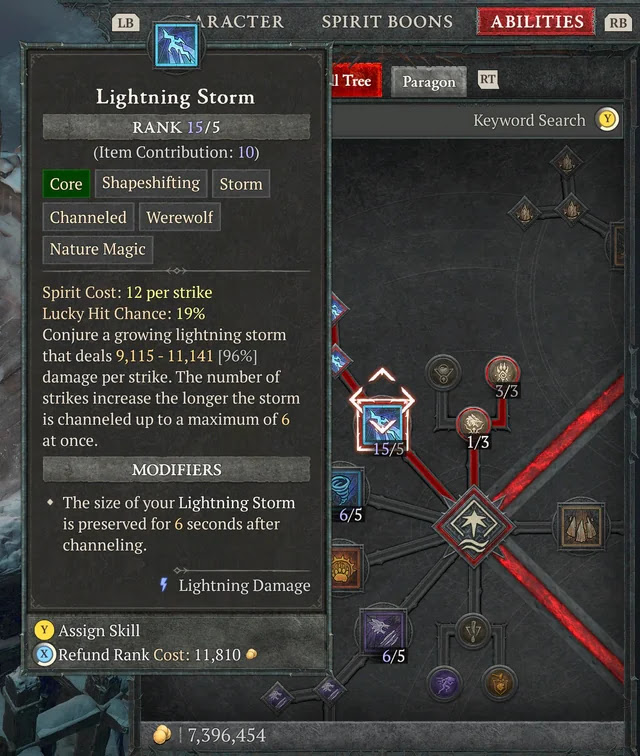
Imagine this: A lone Druid, standing amidst the chaos of Sanctuary, calls forth a storm of epic proportions. Lightning crackles and dances around them, obliterating foes with a raw, elemental fury. This isn't a scene from a high-budget fantasy movie, but a reality in the world of Diablo 4, where one player has managed to push the boundaries of what's possible with the Lightning Storm skill.

In the heart of the storm, this player has managed to level up the Lightning Storm skill to a whopping rank 15, turning their character into a veritable tempest of destruction. The result? A character that can dish out an electrifying 9,115 - 11,141 damage per Lightning Storm attack. Talk about a shocking development!


The Art of Skill Building

So, how did this player achieve such a feat? Well, it all comes down to the art of skill building. In Diablo 4, each character class has its own unique skill tree, and players earn skill points as they level up their characters and delve into the game's Renown system.

The Renown system, for those who aren't in the know, is a set of additional activities available in the five major regions of Sanctuary. By exploring this system, players can earn extra skill points, allowing them to customize their skill trees with up to 58 skill points. It's like a buffet of power, and players can pick and choose the skills that best suit their playstyle.

The Rise of the Druid

Now, let's talk about the Druid class. Once considered the runt of the litter, the Druid has undergone a transformation worthy of its shapeshifting abilities. Thanks to players like our lightning-wielding friend, who goes by the name CrypticGorillaCaulk on Reddit, the Druid class is now a force to be reckoned with.

CrypticGorillaCaulk shared an image of their skill tree, showing the 15 skill points invested in Lightning Storm. This investment has not only turned their Druid into a living, breathing storm, but also sparked a discussion among the Diablo 4 community about the viability of the Druid class.

In the wake of this revelation, other players have chimed in, expressing their admiration for the number of skill points invested in Lightning Storm and discussing the disparity between the builds of the five classes. The consensus? The Druid, once considered the worst class in the Diablo 4 beta, is now in a pretty good spot.

The Gear of the Storm

Of course, it's not just about the skills. Gear plays a crucial role in maximizing a character's potential. In addition to turning their Druid into a literal version of Zeus, CrypticGorillaCaulk revealed that they use a lot of cooldown-focused gear and Hurricane Boots. This combination not only boosts their damage output but also allows them to use Lightning Storm frequently. It's like having your own personal thunderstorm on speed dial!


The Future of Diablo 4

With Season 1 of Diablo 4 underway, Blizzard has revealed several statistics about the first week, including the fact that players created over seven million characters. For those inspired by CrypticGorillaCaulk's electrifying playstyle, there's plenty of new content to explore, including new monsters and dungeons.

So, are you ready to step into the storm? Diablo 4 is available now on PC, PS4, PS5, Xbox One, and Xbox Series X/S. Whether you're a seasoned veteran or a newcomer to the series, there's never been a better time to dive in and start creating your own unique build. Who knows? You might just be the next player to make a shocking discovery!

Conclusion

In the world of Diablo 4, the only limit is your imagination. From leveling up skills to choosing the right gear, every decision shapes your character and your journey. As the story of CrypticGorillaCaulk shows, even the most underappreciated class can rise to greatness with the right build. So, what are you waiting for? It's time to step into Sanctuary and unleash your own storm!